Showing posts with label Characters. Show all posts

Mad-Eye and Frankenstein: A Monstrous Introduction!

Mad-Eye Moody is one of JKR's most fascinating characters, even in GoF when he is basically an impostor. The reader first hears about Mad-Eye a chapter before he is brought onstage, through the varied opinions of other characters. Using the positive and negative (and sometimes false) opinions of others is a great way to lay the foundation and reputation of a new character.
   "Mad-Eye Moody?" said George thoughtfully, spreading marmalade on his toast. "Isn't he that nutter -"
   "Your father thinks very highly of Mad-Eye Moody," said Mrs. Weasley sternly.
   "Yeah, well, Dad collects plugs, doesn't he?" said Fred quietly as Mrs. Weasley left the room. "Birds of a feather. . ."
   "Moody was a great wizard in his time," said Bill.
   "He's an old friend of Dumbledore's, isn't he?" said Charlie.
   "Dumbledore's not what you'd call normal, though, is he?" said Fred. "I mean, I know he's a genius and everything.. ."
   "Who is Mad-Eye?" asked Harry.
   "He's retired, used to work at the Ministry," said Charlie. "I met him once when Dad took me into work with him. He was an Auror - one of the best. . . a Dark wizard catcher," he added, seeing Harry's blank look "Half the cells in Azkaban are full because of him. He made himself loads of enemies, though. . . the families of people he caught, mainly. . . and I heard he's been getting really paranoid in his old age. Doesn't trust anyone anymore. Sees Dark wizards everywhere."
Notice how JKR uses motherly corrections from Mrs. Weasley to highlight George's comment that Mad-Eye is a nutcase. Through this preliminary work, JKR lays the base for Dumbledore's trust of Mad-Eye and an excuse for Mad-Eye's extreme paranoia that will be shown throughout the book.  Still, she uses Fred and George -- who in their role of tricksters have the remarkable ability to view their world outside the status quo -- to question whether Mad-Eye is truly all right and to plant a thread of suspicion upon him.
   A man stood in the doorway, leaning upon a long staff, shrouded in a black traveling cloak. Every head in the Great Hall swiveled toward the stranger, suddenly brightly illuminated by a fork of lightning that flashed across the ceiling. He lowered his hood, shook out a long mane of grizzled, dark gray hair, then began to walk up toward the teachers’ table.
   A dull clunk echoed through the Hall on his every other step. He reached the end of the top table, turned right, and limped heavily toward Dumbledore. Another flash of lightning crossed the ceiling. Hermione gasped.
   The lightning had thrown the man’s face into sharp relief, and it was a face unlike any Harry had ever seen. It looked as though it had been carved out of weathered wood by someone who had only the vaguest idea of what human faces are supposed to look like, and was none too skilled with a chisel. Every inch of skin seemed to be scarred. The mouth looked like a diagonal gash, and a large chunk of the nose was missing. But it was the man’s eyes that made him frightening.
   One of them was small, dark, and beady. The other was large, round as a coin, and a vivid, electric blue. The blue eye was moving ceaselessly, without blinking, and was rolling up, down, and from side to side, quite independently of the normal eye - and then it rolled right over, pointing into the back of the man’s head, so that all they could see was whiteness.
   The stranger reached Dumbledore. He stretched out a hand that was as badly scarred as his face, and Dumbledore shook it, muttering words Harry couldn’t hear. He seemed to be making some inquiry of the stranger, who shook his head unsmilingly and replied in an undertone. Dumbledore nodded and gestured the man to the empty seat on his right-hand side.
   The stranger sat down, shook his mane of dark gray hair out of his face, pulled a plate of sausages toward him, raised it to what was left of his nose, and sniffed it. He then took a small knife out of his pocket, speared a sausage on the end of it, and began to eat. His normal eye was fixed upon the sausages, but the blue eye was still darting restlessly around in its socket, taking in the Hall and the students.
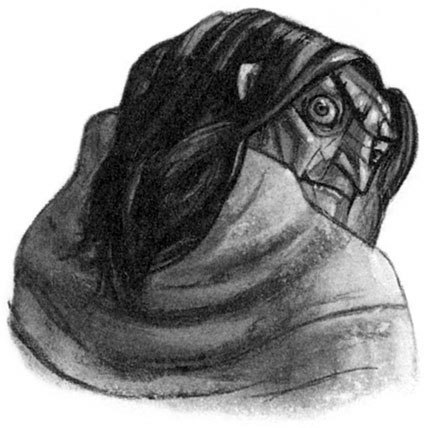
All in all, a great introduction of an awesome character.  But where to begin to analyze this?  JKR just throws out so many well-crafted details, many of which point to clues to Pseudo Mad-Eye's ultimate purpose in this story.

1) Words like "shrouded," "limped," "speared," "unsmiling," "undertone," and "darting" cloak Mad-Eye as a man of mystery, action, and distrust.

2) This lack of his trust of others is reiterated with actions such as his eye rolling all around, into the back of his head to study everyone and everything around him, sniffing his sausages, his unblinking, always wary eye, and even the dull echo of his clunking gait across the floor, which hints at his tremendous losses, both physical and emotional.

3) Notice the wonderful, vivid descriptions such as "carved out of weathered wood" -- not just any wood.  That weathered helps the reader know, this man has been through a lot.  That "long mane of grizzled, dark hair," also lends to his crusty personality.  Add to that the diagonal gash for a mouth and the nose minus a few chunks and you've got yourself a fabulous description that portrays a man who, using one of my father's expressions, has been "run hard and put up wet!"

With the extreme care which JKR has used to introduce this character, the reader should know that this man is important to this story.  Put all these parts together and you've got a most unusual man, a man who's seen the dark side of life, faced physical harm, distrusts must everyone around him, but a man whom Dumbledore trusts and welcomes brightly.

Notice, however, that JKR does give a couple of hints toward this character's ultimate end -- that "fork of lightning" above his head is no accident.  To fork is to divide into two or more branches.  Pseudo Mad-Eye as impersonated by Barty Crouch is definitely a divided man.  Perhaps a stronger hint are the "eyes that made him frightening."  If eyes are the mirrors of the soul, then this man's "small, dark, and beady" and unblinking should strike fear into the heart of the reader!

But perhaps the greatest clue of all is the subtle hint of a literary metaphor at work here.  Do you get the feeling that Mary Shelley might have had an influence in the creation of this Frakensteinesque Auror?  What with the flashes of lightening, the hints of an inept creator, and the scars and mismatched eyes that make it appear as if Mad-Eye was put together from various other people (as indeed Pseudo Mad-Eye was!).  Shelley's monster was abandoned by his father-creator, turning him into a murdering, lost son -- much as Barty Crouch Jr. was.  Indeed, at the end of Shelley's work, when the monster Frankenstein created and abandoned, nameless, tells his tale of woe, one feels more sympathy for him than for his creator -- as I felt myself for Crouch Jr. as well.

Combine the forked lightning and shifty eyes with the hints of a Frankenstein created monster and Geroge and Fred's earlier banter that hints at distrust, and the reader should definitely be looking beneath this stranger's shrouded cloak into his mysteries.  With these subtle clues, reader you have been warned.  "CONSTANT VIGILANCE!"  Even for the man who will soon teach Harry this crucial lesson in class.

As writers, we introduce characters to our readers all the time.  Many require straightforward weaving of description with action that bring that character to life.  But a few will challenge us to use our highest skill.  Those characters that must fool our reader for a time period, we must pay particular attention to.  While it is ok to play sly and fool your reader, you don't want to outright deceive them unfairly.  Clues, as subtle as possible, must be present, even from a character's first introduction.  Through the use of a subtle literary metaphor, opinions of others, and shifty eyes, JKR gave a hint to the alert reader that all was not what it seemed with Mad-Eye, while at the same time presenting him as a man whom Dumbledore trusted, a wounded her, and an altogether fascinating creation.

I'm curious to know -- what did you all think of Mad-Eye when you first met him?  Were you alerted?  Were you fooled?  At what point had you figured out he was the prime antagonist?

You may also be interested in my post about the link between Mad-Eye's magical eye and the Eye of Horus.

Picture credits: Mad-Eye pic from movie
drawing of Mad-Eye by Mary GrandPre

Driving a Stake Through the Heart of Your Characters

Stakes.  As the only thing that will kill the living dead, it's the bane of vampires and sometimes zombies.  Apparently, it also stabs fear into the heart of the writer trying to breathe life into their characters.

Strong character hearts require strong emotions, and strong emotions result from high stakes. You want your emotions to hit the highest pitch possible. You must have the reader experience fully the passions of your characters, whether those emotions be love or hate, trust or betrayal, laughter or sorrow. Escalate your reader's experience by raising the bar for what's at risk.

We can't all write a story about a poor, unloved, defenseless orphan who must save the entire wizarding world, indeed the Muggle world as well, from the darkest and most powerful wizard who ever lived. Not all stories can be set in this frame of stake-hood.

However, whether writing a cozy mystery, a witty women's fiction, or an emotionally charged thriller, your stakes need to be as high as is appropriately possible. Brainstorm--what is the worst thing that could happen to your hero or heroine, and then make it your plot. The higher the risk, the more rewarding that character's triumph will be.

One aspect of high stakes I feel is extremely important is that not just the hero or heroine benefit from their resulting success. The good of a community, no matter how large or small, must also be at risk. It's the carrying the elixir back to the tribe of the "hero's journey." Triumph over the antagonist is so much richer when there's a community of people who benefit from it.

With Harry Potter, we have the large end of the spectrum when it comes to a community benefit. Wizards and Muggles alike will enjoy a more peaceful world when Voldemort is no more. However, even a story that is focused tightly on the burgeoning romance between two people can include the return of the elixir. A family can be reunited, a neighborhood can be returned to order, or as in Two Weeks Notice, a community center protected and restored. The possibilities are as endless as your imagination.

High stakes should also show your characters not only at their best, but also at their worst. Many readers had trouble with Harry in Order of the Phoenix. This was Harry's fifth year of school, and at age fifteen, he was every bit the angry, angsty, antagonistic teenager that no one but his own equally angsty friends wants to be around. I got tired of Harry's tantrums in that book as well.

But it was real. After all, here was a teenager who had a lot of weight on his shoulders, so much that Dumbledore did not make him a prefect because he thought Harry had quite enough to be carrying on with.

Note that when writing a series, as in HP, the stakes must increase with each subsequent book. The hero's task cannot get easier, or there'll be no satisfaction for the reader. Harry goes from maintaining his own against a mere parasite at the end of Philosopher's/Sorcerer's Stone, to saving an innocent man from death or de-souling in PoA, to leading the capture of a pack of Death Eaters in Order of the Phoenix, to facing the ultimate showdown and making the ultimate sacrifice in Deathly Hallows.

Harry has been tested and tried since the very beginning. He has been pushed into developing skills, such as producing a Patronus that other witches and wizards his age would never consider. He must be pushed in this manner because he has an enormous task ahead of him.

No one will believe that a seventeen-year-old wizard could defeat the darkest wizard in 100 years, unless he'd been properly prepared and thoroughly tested. And no one will believe your heroine deserves her triumphant ending unless she's proved to herself, along with the reader, that she can survive and triumph over any obstacle her mean-hearted author has thrown at her.

Your protagonist doesn't have to “save the world.” For writers, stakes are emotional, not physical. What your protagonist does have to do, however, is face his or her worst possible fears, probe their deepest inner wound, pass through the fires of refining conflict, and emerge a better, stronger person on the other side.

Have no mercy! Raise your stakes to bring out the full emotional depth your hero must face and rise above. Torture and torment your characters to make them prove their worth.

After all, you won't have to meet him in real life. :-)

Those Tricky Twins and That Peevish Peeves

Following in my series on archetypes as started with Threshold Guardians and the Forbidden Door, I would like to look at a storyline archetype that, in the write hands, can be one of the funnest to portray. Tricksters.

Tricksters are usually the center of fun, mischief, and mayhem in the story. They delight in upsetting the status quo or in “taking the mikey” out of other characters or the hero. They present the hero with a challenge unlike other characters as they question authority and promote chaos--encouraging the hero to question as well.

For tricksters in Harry Potter, we need look no further than Fred and George Weasley. They fit the Trickster description to a Wesley sweater embroidered T. Their spiritual counterpart is Peeves, which is why it was so delightful at the end of OotP, when Gred and Forge passed their mischievous torch to Peeves, and he seized it wholeheartedly.

Like many fans, I find Peeves and the twins’ antics totally amusing, and I fully understand why Dumbledore keeps Peeves about the place. In holding your reader's attention, it’s important to have someone kick things up a bit, to foster a constant element of surprise.

Without the Trickster upsetting the status quo, life would not only be duller, but the hero’s path more difficult. Tricksters provide aide for the Hero, if only indirectly. Not only can they poke the hero’s flaw (oh Potter you Rotter) quite painfully, but by showing clearly a different mindset, an opposing world view, an alternate way of being, they enable the hero to do the same. As Ginny says, when you’ve hung around Fred and George for a while, you start believing anything is possible.

JKR magnificently uses her Tricksters to not only upset the status quo, but to propel her hero onward in his quest. Without Fred and George, Harry would definitely not have discovered as many secrets about Hogwarts and his father. And without Peeves poking at his wounds, Harry might not have peered as deep into his own inner conflicts.

In what way have you used a Trickster archetype recently?

Peeves picture credit.

Clue Technique -- Discredit Your Witness

In an earlier post, we discussed how the magical JK Rowling uses diversion to masterly distract the reader from any clues which she lays. She employs several techniques for drawing our attention away from these tidbits, which we can utilize in our own stories. In this post, we'll look at one.

One way you can hide a clue is to make the person who reveals it look like a complete idiot. For JKR, Trelawney and Luna seem to be the biggest target for hiding these sly nuggets. They simply spout so much nonsense, each in her own way, that you don’t expect them to ever get anything right. Fudge is a similar character. So, once a character has been discredited, he or she becomes a prime candidate for laying an important clue.

Of course, what Trelawney’s most famous for are her two “true” prophecies--the one that led Voldemort to Harry on that fateful Halloween, and the one about Wormtail returning to his master--but she also makes an accurate prediction in Harry’s very first lesson:

     "My dear," Professor Trelawney's huge eyes opened dramatically, "You have the Grim."
     "The what?" said Harry.
     He could tell that he wasn't the only one who didn't understand; Dean Thomas shrugged at him and Lavender Brown looked puzzled, but nearly everybody else clapped their hands to their mouths in horror.
     "The Grim, my dear, the Grim!" cried Professor Trelawney, who looked shocked that Harry hadn't understood. "The giant, spectral dog that haunts churchyards! My dear boy, it is an omen -- the worst omen -- of death!"
     Harry's stomach lurched. That dog on the cover of Death Omens in Flourish and Blotts -- the dog in the shadows of Magnolia Crescent...
 (p. 107, PoA)

Trelawney is presented as a charlatan, McGonagall discredits her entirely and tells Harry she’s predicted a death every year, and the reader knows quite well Harry’s not going to die in book 3 of a 7-book series (which JKR had already announced). So, who would pay attention to the very real clue that death is attached to the Grim? It’s not Harry’s death that’s being foretold, however, it’s the dog’s death...it’s Sirius’. The Grim, Sirius’ animagus alter-ego, finally catches up to him at the end of OotP.

Taking Trelawney seriously is one thing...but Luna...? Still I think Luna was on to something big. From her (or her father’s) accusations that “Fudge’s dearest ambition is to seize control of the goblin gold supply” (p. 174, OotP Bloomsbury), to Scrimgeour being a vampire (p. 294, HBP, Bloomsbury), to the Aurors as part of the Roftang Conspiracy to “bring down the Ministry of Magic using a combination of Dark magic and gum disease” (p. 299, HBP, Bloomsbury), she seemed to be hitting rather hard that something was rotten within the ministry and a battle for power was imminent. In Deathly Hallows, one of the first things to happen was the fall of the Ministry, toppled from within.

So, if you’ve done the work to create an outlandish character, utilize one of JKR’s techniques and put the character to extra work by giving her an outlandish clue to hide that the reader will never suspect. Make sure she truly does spout nonsense most of the time, or the reader will catch onto you and start taking your character seriously. Remember, it’s always sleight-of-hand, distraction, that you’re going for.

Do you have a clue you need to plant which would be great coming out of the mouth of a character your writer won't take seriously?  If so, please share in the comment trail!

This article is part of the Sleight of Hand series with tags of  Mystery Plotting and Clues.

Picture credits: Prof. Trelawney, Luna Lovegood

Mad-Eye's Mad Eye

I want you to look at the three images I have on this post and see if you recognize any similarities.

Let's start with the first image, the ancient Egyptian Eye of Horus.

The Eye of Horus was an amulet of healing and resurrection. One of the most revered and powerful amulets in ancient Egypt, the Eye provided protection from evil. It was a symbol of royal strength and assisted in the rebirth of the deceased.

As the granddaddy of apotropaic amulets, meaning a talisman that turns back harm or evil, the eye amulet was so popular that it spread throughout the region and the centuries, morphing and adapting to various cultures, but always retaining the staring single eye. It is truly very old magic.

The Eye still exists in various incarnations even today. It is very popular throughout the Middle East, especially in Turkey where it is known as nazar boncugu. In Turkey you will still see this amulet nailed over doors to homes, decorating the hulls of ships, and pinned to the clothing of young children, placed there protectively by their loving mothers.

Now let's look at Mad-Eye's mad eye.
From Goblet of Fire:
But it was the man's eyes that made him frightening.

One of them was small, dark, and beady.  The other was large, round as a coin, and a vivid, electric blue.  The blue eye was moving ceaselessly, without blinking, and was rolling up, down, and from side to side, quite independently of the normal eye -- and then it rolled right over, pointing into the back of the man's head, so that all they could see was whiteness.  (p. 184-185)

Hmm. An all-seeing round eye with the colors of black, blue, and white... Ya think there's a connection?

A few years ago, when E.L. Fossa of Wizarding World Press pointed out to me the similarities between JKR's creation and the Turkish nazar boncugu, I felt a bit dimwitted.  Here I was, married to a Turk, having lived in Turkey many years, with many boncuks hanging in my house, on my keychain, or pinned to my children's clothes when they were babies, and I'd not made that connection.  Yet, I was only then learning how to look below the surface in a Harry Potter novel.

If I'd had any remaining doubts that JKR intended for the reader to make these connections, it was  was when she had Umbridge nail Mad-Eye's glass eye to her office door that cinched it for me.  On the surface, that was just a bit odd.  And you can bet, whenever JKR is doing something that seems odd or slightly out of place, that she's getting at a deeper meaning, most likely using a mythological reference.

But ... why would JKR pin a benevolent amulet onto a character who in the first book is a Death Eater and fraud?  I think there's an initial reason, and then a deeper one that leads to the underlying mystery of the series.

First the initial reason -- the Eye of Horus, as well as its descendant, the nazar boncugu, are amulets that represent protection from an all-seeing divinity.  In Goblet of Fire, pseudo Mad-Eye (aka Barty Crouch, Jr.) fills this role.  He sees all, knows much more than any other character what is truly going on, and is bent on protecting Harry and getting him through as champion in the Tri-Wizard Tournament.  Unfortunately, all this protection is aimed at providing Harry as a sacrifice to his lord and master, Voldemort.

However, in the end, despite himself, Crouch's protection works effectively.  It is Barty Crouch as Mad-Eye who taught Harry how to throw off the Imperius curse, an ability that helps Harry survive his encounter with the Dark Lord and return safely to Hogwarts.

As writers, we have the option of working sub-textual meaning into our stories.  If we do so with skill and resonance, as JKR has done with Moody's eye, then we've provided a whole new layer for the reader to engage within our pages, time and time again.

So, why would JKR draw so much attention to this ancient Eygptian amulet?  I have a theory and it points to the Horcruxes.  But that's a huge 'nother post.  I'll try to do it this weekend, so check back.

Wouldn't you love to hang Moody's magical eye on your door?  Win a Turkish evil-eye bead by following this blog..

Photo credits:
Eye of Horus
Nazar Boncugu
Mad-Eye Moody 
Door with Boncuk, Turkey

Dumbledore's Theme Song

"Ah, music...A magic far beyond all we do here!" (PS p. 95)

Music and Dumbledore. The two just seem to go together, don't they? We know from his chocolate frog card that he "enjoys chamber music" as well as tenpin bowling. But the music vibes deeper than that. Music, for Dumbledore, touches his very soul.

Dumbledore, like his namesake the bumblebee, seems to always be humming about the castle. And then there's his pet, Fawkes, the phoenix. Fawkes not only represents Dumbledore's Patronus, but his anima, a projection of his soul, which restores Harry, not once, not twice, but three times with the power of music.

It is with "eerie, spine-tingling, unearthly" music that Fawkes appears in the Chamber of Secrets and drops the Sorting Hat to Harry, thus giving him the sword of Gryffindor and his means to defeat the Basilisk.

Then, in Goblet of Fire:
...an unearthly and beautiful sound filled the air. ... It was coming from every thread of the light-spun web vibrating around Harry and Voldemort. It was a sound Harry recognized, though he had heard it only once before in his life: phoenix song. It was the sound of hope to Harry. . . the most beautiful and welcome thing he had ever heard in his life. . . . He felt as though the song were inside him instead of just around him. ... It was the sound he connected with Dumbledore, and it was almost as though a friend were speaking in his ear. . . .

Don't break the connection.
In HBP:

When Harry passes along to Dumbledore how he'd answered Scrimgeour's accusation of his being Dumbledore's man through and through with a proud affirmative:
Dumbledore opened his mouth to speak and then closed it again. Behind Harry, Fawkes the phoenix let out a low, soft, musical cry. To Harry’s intense embarrassment, he suddenly realized that Dumbledore's bright blue eyes looked rather watery, and stared hastily at his own knees. (Bloomsbury, 334-35)

At Dumbledore's death in HBP:
And Harry felt, as he had felt about phoenix song before, that the music was inside him, not without: It was his own grief turned magically to song that echoed across the grounds and through the castle windows.

How long they all stood there, listening, he did not know, nor why it seemed to ease their pain a little to listen to the sound of their mourning...

Why would JKR make these connections between Dumbledore and Fawkes and music? Maybe she's playing on a character theme here, on the essence of Dumbledore.

Most writers are familiar with story themes--the central idea, or meaning, of a story. But you can have themes centered on a character as well. Knowing your character's theme helps you as a writer to convey consistently the essence of that character. And if your essence is Bellatrix, according to Hermione when tasting her Polyjuice, that is quite disgusting.

A character theme is not necessarily a main personality trait, though it can be.  Character themes can also focus on a core belief (such as Draco's privileged disdain for mudbloods), a physical feature if it has a profound impact on that character (such as Mad-Eye's mad eye), or something more esoteric (like in Harry's association with the alchemical Philosopher's Stone and Dumbledore's affinity with music and the resurrecting Fawkes).

For an example of how a character theme can play out in the story, let's look at Ron.  Ron is Harry's loyal friend, and the reader sees this in the many words and images JKR writes for Ron -- his constant support and companionship, his defense of Harry when the rest of the school considered him to be the Heir of Slytherin, his welcoming Harry into his home and family, and his willingness to risk his life to save his best friend's.  Even though Ron's loyalty is put to the test once or twice, it is precisely because loyalty is what Ron is all about that he's tested in this manner.

Other character themes which JKR plays with:

  • Hermione -- the Brain (Is that why Ron was attacked by a brain in the DoM? :-) The reader is given numerous references to Hermione's intelligence and love of books.
  • Neville -- yes, Neville is forgetful, but I think his deeper theme would be something like "untapped potential."
  • Uncle Vernon -- Have you ever noticed how often angry words and a purple face are used to describe Harry's "loving" uncle? I think his theme would be raging intolerance.
  • Aunt Petunia -- rigid clean freak--numerous refs to her cleaning, or her spotless home, and think of her reaction to Marge's visit with her dog
  • Hagrid -- monster-loving, almost like muggle-loving, but way more dangerous
  • Snape -- vitriol--as in repressed anger, resentment, and self-blame eating him out from the inside

And finally, again, Dumbledore -- Dumbledore's theme is not simply music, but Phoenix song, music that restores the soul, that resurrects life. It's Dumbledore's theme song which plays deeply into the heart of the Harry Potter saga and which carries Harry through in his final confrontation with Voldemort.

JKR applied her Polyjuice potion to brew out the essence of her main characters, as well as the secondaries.  She knew intimately what they were all about and wove these tidbits into her story to portray them three dimensionally on two-dimensional paper. If you know the heart of your character, then you can breathe life into their being. JKR used these themes through consistent references describing that character's manner of being, words, and actions.

As a writer, have you thought of the essence of your characters?  If you had to describe the look and taste of their Polyjuice potion, would it be disgusting like Bellatrix's,  "the khaki color of a booger" like Goyle's, or a "clear, bright gold" like Harry's?

What other character themes can you see within the Potterverse?  Or, what is one of your own creation?

** Picture credit for Fawkes.

All the Kreacher's Men

One excellent way to demonstrate character in a story is to show how your hero or secondary treats other people.  Or, in the words of the immortal Sirius Black, "If you want to know what a man's like, take a good look at how he treats his inferiors, not his equals." (GoF, p. 525)  Through the course of the last three books, JKR gives the reader insight into the character of three men based on how they treat one considered an inferior, a house-elf named Kreacher.

Sirius Black -- In Order of the Phoenix, Sirius hates the sight of Kreacher and treats him terribly. But it is not Kreacher himself whom Sirius hates as much as it is what Kreacher stands for. Kreacher is the last surviving remnant (aside from Sirius) of the pureblood, aristocratic, and extremely bigoted Black family. Sirius seems to hate everything about his family and what they stood for, which resulted in him running away at sixteen to go live with Harry's father, James. Sirius' mother subsequently blasted him from the Black family tree tapestry.

Unfortunately, this very understandable feeling Sirius harbors towards his family's prejudices results in him treating one beneath him with an attitude bordering on his family's bigotry. And in the end, is what causes Kreacher to fatally betray Sirius to his Death Eater cousin Bellatrix.

Lord Voldemort -- In the "Kreacher's Tale" chapter of Deathly Hallows, Kreacher reveals to Harry, Ron, and Hermione how his master, Sirius' brother Regulus, a Death Eater, had requested that Kreacher go with Lord Voldemort on a secret mission. This mission involved Kreacher accompanying Voldemort to hide his Horcrux locket in the cavern. Voldemort wished for a house-elf to accompany him because he considered the elf's magic less important and the elf himself expendable. Voldemort forced Kreacher to drink the basin of poison and then left the elf alone to die at the hands of his zombie-like Inferi.


Regulus Black -- In this tale of three men, it is Regulus Black, Sirius' deceased brother and former Death Eater, who comes out the hero. Upon Kreacher's return to the Black family home (having escaped the Inferi due to his special powers and loyalty to Regulus), the elf tells his favored master all that occurred. Regulus has Kreacher return with him to the cave and show him the way to the Horcrux. But instead of having "the inferior" house-elf drink the potion for him, as Voldemort did, Regulus drinks it himself, condemning himself to death at the hands of the Inferi. Regulus' last request is for Kreacher to return home safely with the locket and destroy it.

Harry -- I said this was a tale of three men, but truly it all comes down to Harry. Up until the point of Kreacher's Tale, Harry first treated the house-elf as a grotesque curiosity, and then, after Sirius' death, as an object for his blame and hatred. But when Harry realizes how Kreature had been abused at Voldemort's hands and by his potion, and why the house-elf was so blindly loyal to the Black family, then Harry's heart softened, and for the first time, he treated Kreacher as someone other than a creature, but human, and deserving of his respect.

As a character, Kreacher has two important roles. To the plot, he is important for hiding and revealing this clue regarding the locket Horcrux. But I think his deeper purpose in the story is to reveal the inner character of these men, and to show the changing and maturing heart of Harry.

As writers, we have many tools available to show character development.  We can do this through actions, choices, the opinions of other characters, and in this example, in how our hero treats those around him, including his "inferiors."  How have you portrayed the way your hero and secondaries treat others?  Have you included a "touchstone" type of character who reflects the developing arc of your heroine by how she treats this individual?

Contrasts and comparisons.  Foils and shadows.  How powerful it is to show Harry developing beyond his hatred of Kreature to an attitude of trust and respect.  It's almost, but not quite, as powerful as Harry's 180-degree turn toward Severus Snape.

But that's a post for another time.

Be sure to follow the Characterization label below for more examinations of how JKR develops her characters.

A Rubeus by Any Other Name...

Would NOT smell as, well, ah...sweet!

In JK Rowling's deft hands, character names are more than just a reflection of the personality of its owner.  While many writers like to pick apart JKR's prose for overuse of adverbs or other small infractions, one technique she is almost universally admired for is her ability to craft unique, meaningful, and enchanting names.  I mean, siriusly, can you imagine Rubeus Hagrid as a Robert Harris?  Or Albus Percival Wulfric Brian Dumbledore as Albert Davis?

But JKR's talent was not just in giving her characters a whimsical, though accessible, name which made them seem fully a part of their magical world.  It was most importantly her ability to craft a name which carried hints of the mystery surrounding that character.

For example, many fans (myself included) are still convinced that when the Harry Potter Encyclopedia comes out, Dumbledore's animagus form will be revealed as a bumblebee.  After all, Dumbledore is an old English word for bumblebee, and he always seemed to be humming about the place.  And can you imagine that a former Transfiguration professor and a wizard as skilled as Dumbledore never learned to transform himself?

Years ago, when the HP books were new and fans were first beginning to share their enthusiasm over the Internet, the main clues being discussed were the meanings behind names.  Readers quickly caught on that many came from myths; others from places; some were named after flowers or stars; and then there are JKR’s own creations, combinations of words with new meanings (such as Umbridge, a portmanteau from umbrage and bridge, as she provided a connection from the school to the ministry). All types of names were strikingly relevant to the character or object they represented, and most held some sort of clue regarding that character's role in the series.

For example:

  1. Argus Filch = Argus Panoptes from Greek mythology. Argus of the 100 Eyes made a great watchman, just like nasty old Filch.
  2. Petunia = flower name meaning anger and resentment, sounds like petulant
  3. Lily = flower associated with death and resurrection
  4. Bellatrix = the third brightest star in Orion, means female hunter
  5. Draco = Draco constellation, draco means dragon, a reminder of his serpentine Slytherin family.
  6. Grimmauld Place = definitely a grim old place, but it might also be a play on the Brother’s Grimm and a nod to their fairy tales.
  7. Minerva McGonagall = named after the Roman goddess of wisdom and war. She resembles a distant, austere goddess (with a warm side she reveals upon occasion), but a very apt second in command, as shown in Deathly Hallows.
These are all fairly simple examples, accessible to the average reader with just a quick quest to the Google oracle. However, there was one set of names which carried a stronger set of clues to the heart of the mystery surrounding Harry--his alchemical journey.  In alchemy, to turn base metal into gold, there were seven stages divided into three phases--black, white, and then red.  The black phase must “die” for the white to begin, then the white falls away for the red. At last, the red phase produces the gold of the Philosopher’s Stone.

Now look at these three names:

Sirius Black
Albus (white in Latin) Dumbledore
Rubeus (red in Latin) Hagrid

First Sirius died, then Dumbledore, then finally, after a symbolic death from his motorbike, Hagrid was left to carry the body of Harry out of the Dark Forest of his enlightenment for his final confrontation, his golden moment in the rising sun.

Think of ways you can give extra meaning to your character names without creating something that looks like D'Oro'dindul'gum.  JKR's names, while different, were still accessible. Also, be careful in choosing names with meaning that it also fits the character, story, and time period in which the story takes place.

Have you created a character name lately you're especially proud of?

This article is part of the Sleight of Hand series with tags of  Mystery Plotting and Clues.

Photo credit

Snape's Gray Undies

It was one of JK Rowling's most memorable scenes from Order of the Phoenix, one that fans could not wait to see come to life on the big screen, and not just because they were eager to view the four marauders together, alive as teenagers.  No, everyone wanted to see Snape and James go at each other.  And many were dying to laugh at Snape's graying underpants.

    Behind [James], the Impediment Jinx was wearing off.  Snape was beginning to inch toward his fallen wand, spitting out soapsuds as he crawled.
   "I wouldn't go out with you if it was a choice between you and the giant squid," said Lilly.
   "Bad luck, Prongs," said Sirius briskly, turning back to Snape.  "OY!"
    But too late; Snape had directed his wand straight at James; there was a flash of light and a gash appeared on the side of James's face, spattering his robes with blood.  James whirled about; a second flash of light later, Snape was hanging upside down in the air, his robes falling over his head to reveal skinny, pallid legs and a pair of graying underpants. (p. 647, OotP)

I do not think those gray undies are thrown in casually for a bit of nasty flavor.  Indeed, I think JKR possibly crafted this whole scene around them.

This view through the Pensieve opens Harry’s eyes to the fact that he’d placed his father on a pedestal that was both unhealthy and unrealistic. The world is not filled with good people and Death Eaters, but ultimately most of us are various shades of gray. And that’s where Snape’s exposed undies come in. Snape, like his undies, is one of the grayest.

Snape was deliberately constructed by his creator to be a man of uncertain allegiance, trusted by few, doubted by many, living in a world of shadows, existing on both sides of the Dumbledore/Voldemort divide. A man who intentionally concealed secrets and motivations.  A character of ambiguity.


His never-ending morphing keeps the reader off-guard, on the alert, and constantly wondering. Readers latch onto Snape because the uncertainty of his ambiguity commands it. His mysterious nature demands the reader’s questions and inward exploration. What do I think about loyalty, appearances, the power of trust? Do I believe a person can be nasty and mean and still serve a higher good? Do I agree that a Slytherin and a Gryffindor have anything in common and can work together to defeat true evil? And who am I inside? Where do my loyalties lie? Would I defend Snape, or bully him upside down?

Who you are inside will determine how you interpret Snape. Snape will be understood, in your mind, in direct accordance with your worldview. That's why readers were so polarized. Snape draws the reader’s involvement because that is his very purpose.

As writers, we can challenge ourselves to make sure the real world in all its texture and complexity is reflected within our story.  Once you have constructed your hero and antagonist and defined the themes that differentiate them, have you created a character to embody the vast space of grayness that lies between them?  Have you got a Snape, complete with gray undies, ambiguous in nature, who could be viewed as friend and foe by both sides?  A character, who like most of us, is not totally good or evil, but somewhere in between, who embodies the subtle nuances of your theme.  And can you craft this character with a hint of mystery, to keep both your hero, and your reader guessing, as they did with Snape, until the very end?

One last thing to note regarding JKR's craft in the scene snippet above.  See that other highlighted section, the curse Snape threw at James that caused a gash on his head and made him bleed?  What does that remind you of?  A bit of foreshadowing of Half-Blood Prince to come?  We see here Snape using the curse that caused Harry so much trouble with Draco, and the Prince himself, in the next book to come.

A clue, foreshadowing, character development and theme definition, all in one tidy little memory.  That's JKR for you!

Have you written an ambiguous character into your story?  I'd love to hear about it.

Picture credit.

In a Series, Foreshadowing a Character

One thing JK Rowling did throughout her series was to give a cameo to a character in a book before that character truly had a starring role. For example, in the first book, the Dursleys talk about Arabella Figg as Harry's babysitter before she comes out as a squib in Order of the Phoenix. Likewise, Gregorovitch is mentioned as the maker of Krum's wand in Goblet of Fire before he becomes a carrier of an important secret and the target of Voldemort's wrath in Deathly Hallows.

One of JKR's most beloved characters, Sirius Black, is also foreshadowed in an earlier book. In answer to Dumbledore's question as to where he got the motorbike, Hagrid answers:

“Borrowed it, Professor Dumbledore, sir,” said the giant, climbing carefully off the motorcycle as he spoke. “Young Sirius Black lent it to me. I’ve got him, sir.” (p. 14, SS)

Notice that JKR plants Sirius into the very first chapter of her first book, even though he doesn't appear as a true character until two books later with Prisoner of Azkaban. She also gives a hint as to his character and role with that motorbike and his presence at Godric's Hollow.

In Prisoner of Azkaban, JKR gives Cedric Diggory a cameo, even though his starring role is not until the next book, Goblet of Fire.

"Diggory got the Snitch," said George. "Just after you fell. He didn't realize what had happened. When he looked back and saw you on the ground, he tried to call it off. Wanted a rematch. But they won fair and square...even Wood admits it." (p. 180, PoA)

If even Wood admits it was fair, but Cedric was willing to forego a win for a rematch, then he must be a true champion. It's a wonderful, although brief, introduction to the young man whose sense of honor and fair play makes him a winner with Harry in the maze, and then lose his life because of it.

Layering characters into stories in this manner reveals the depths to which JKR plots her series. To a reader, a series feels more real and connected when an important character doesn't just begin and end their career in one book. Readers love a sense of interconnectedness and a well thought-out plot.

If you're writing a series, plot out each book, its plots and characters, far enough in advance, that you can bring onstage characters from a later story and introduce them to your audience before their closeup.

What have you foreshadowed in your story or series?  Have you brought on a character even before they had a starring role?

Threshold Guardians and the Forbidden Door

As writers, whether consciously or unconsciously, we employ the use of archetypes to transport our characters better into the reader's mind. In my understanding, there are two types of archetypes: those I like to call character archetypes which distinguish personalities (the nurturer, the librarian, the femme fatale, the bad boy), and another set I call storyline archetypes (the hero, the trickster, the shadow, the mentor, the threshold guardian) which defines that character's role in the story.

Each of these sets of archetypes deserve a post on their own, which I will do in the future. Today, however, I'd like to focus on one particular storyline archetype--the threshold guardian.

Threshold Guardians are placed at portals to new worlds or gateways to new challenges to keep the unworthy out. A Guardian may be a good-hearted ally of the hero, looking out for his best interest, or he may be an accomplice of the villain, seeking to harm or hinder the hero from completing his quest. Either way, as part of his quest, the hero will be tested by his ability to overcome or win over the many Threshold Guardians he will encounter along the way.

From the Portrait of the Pink Lady, to Dobby sealing the entry to Platform 9¾ in CoS, to the grindylows guarding the “treasures” in the lake during the Triwizard Tournament, Harry encounters numerous thresholds and their guardians throughout the series. However, I’d like to focus on one type of Gateway and Guardian to look at closer.

In his book The Writer's Journey, author Christopher Vogler talks about the Law of the Secret Door (p. 112-113) (also related to Carl Jung's "Forbidden Door"). Many myths include a set-up whereby the heroine is told she must never eat from a certain tree, never open a certain box, or never pass through a certain door, upon pain of death. Of course the myths I’m referring to are Eve in the Garden of Eden, Pandora with her box, and Belle in Beauty and the Beast. We all know what happens, what is sure to happen anytime this sort of situation presents itself in a story. If you have children, you probably have this happen quite regularly in your life as well.

The power of curiosity is universal. In the words of the immortal Dumbledore, "Curiosity is not a sin.... But we should exercise caution with our curiosity... yes, indeed" (p. 598, GoF). Whereas later in the series Harry more strongly develops his own driving need to set the world right by stopping Voldemort, in the first three books, curiosity is one of the prime motivators driving on Harry, Ron, and Hermione.

It seems to me there is a forbidden door in each book, and a guardian to go with it. This forbidden door leads directly to the Inmost Cave where the Ordeal (part of the Hero's Journey that we will discuss in another post) occurs:
  1. PS/SS -- Forbidden Door: right hand side of the third floor corridor that they are forbidden from entering
    Guardian: Fluffy

  2. CoS -- Forbidden Door: haunted girls’ restroom (with Percy forbidding Ron to go anywhere near it)
    Guardian: Moaning Myrtle

  3. PoA -- Forbidden Door: The Shrieking Shack
    Guardian: Whomping Willow (and Crookshanks leads the way)
  4. Beyond these first three books, the Secret Door and its Guardian gets a bit murkier, but they’re still there.
  5. GoF -- Forbidden Door: Portal to the Graveyard
    Guardian: Pseudo Mad-Eye. This is an interesting one because not only is Pseudo Mad-Eye the portal’s Guardian, he’s also a shapeshifter in disguise. Talk about combining your archetypes!


  6. OotP -- Forbidden Door: Harry’s mind holds the secret door in this book. His dreams show him clearly the secret door to the DoM, and his mind holds the “forbidden” and dangerous connection to Voldemort.
    Guardian: Snape, through Occlumency lessons, guards the door to Harry’s mind.

  7. HBP -- Forbidden Door: Tom Riddle’s cave is symbolic of the secret door which was forbidden him as a youth and he has explored fully as an adult.
    Guardian: Voldemort has set many protections on his cave to protect his Horcrux, but it seems to me that the Inferi serve as the classic Threshold Guardians.

  8. DH -- Forbidden Door: I would argue that the secret door in this last book is one that Harry, in the end, refuses to break into. It is the door into Dumbledore’s tomb to retrieve the Elder Wand. Voldemort violates this sacred space, stealing the wand, whereas Harry finally gets control over his fears and ambitions and follows Dumbledore’s wishes by focusing on the Horcruxes and leaving the Elder Wand to Voldemort.
    Guardian: Dumbledore would thus be the guardian of this last secret door.
Forbidden Doors are special thresholds and great tools for writers. They set up reader expectation for something powerful and dangerous to occur once that gateway is breached. They pull your readers in, engaging their own curiosity as they urge your heroine on through the secret door, then hold their breath as to what fate will befall her for her trespass. Make sure you have a powerful, interesting Guardian for such a special door.

Can you name some other Threshold Guardians from Harry Potter, both Secret or other? Have you worked with the Law of the Secret Door in any of your work?

Picture credit