Showing posts with label World Building. Show all posts

Creating a Diagonal World

Continuing in our First Chapter Series of posts, I now enter JKR's delightful and amazing portal to world building. Before Hagrid takes Harry to Diagon Alley, JKR shows the reader through this first chapter that the exciting, enchanting wizarding world is only diagonally separated from the Muggle. Here is a fantasy where reality and the imagined world co-exist, but are not mingled as one. The secret world, the shadow realm, is a place hidden away in enchanted castles, inner-city streets, and all-wizarding villages. Still, when momentous events occur, the colorful spells shoot like stars into the air, the messenger owls fly to and fro, and the odd and cloaked wizards hug unsuspecting and unappreciative Muggles on the city streets.

So, what techniques did JKR employ in this first chapter to gently introduce her reader to the full-blown wizarding world which awaited in the chapters to come?  We'll look at the following craft techniques:


  1. Introduce the Magic
  2. Stir the Cauldron
  3. Use References to Carry You Further Afield
  4. Name Your World
  5. Imbue with Meaning
(Please note: I have numerous posts on JKR's world building in this blog that cover far more details on how she creates her worlds overall. This post relates only to the first chapter.)

1) Introduce the Magic:

Whether to drop your reader full-force into your created world, or gently nudge them in that direction as JKR did, will depend on your genre, story and tone. While stories set in your readers' contemporary real world have less foreign elements to introduce, the writer must still uncover the unique details of the specific location her characters inhabit. On the exact opposite end of the world building pole, writers of entirely created fantasy realms have an entire arsenal of details to acquaint their reader with.


The unifying technique which both sets of writers can glean from studying JKR's first chapter is to start with the comfortingly familiar and gradually introduce your reader into the more exotic elements. By starting with the familiar Muggle world, JKR immerses her readers into what they could readily identify with, thus allowing them to become full participants in the action to come.

This technique worked very well for many readers who did not normally read fantasy, such as myself. She clued us in from the start that here was not a world totally removed from our own, but rather one that breathed and existed alongside or diagonally connected to it, at times intersecting in odd and exciting ways. However, as our feet never left the solid Muggle ground of Privet Drive in this first peek into her magical realm, we were not overwhelmed with a place or people we had no part of.


2) Stir the Cauldron:

"The Boy Who Lived" chapter is masterfully orchestrated to build from the incongruous sight of a cat reading a map -- the first sign of the magical world -- to the onslaught of weird people in cloaks, oddly behaving owls, and shooting stars all over the country.  All this preliminary lead-to culminates with Albus Dumbledore's appearance on Privet Drive.


Nothing like this man had ever been seen on Privet Drive. He was tall, thin, and very old, judging by the silver of his hair and beard, which were both long enough to tuck into his belt. He was wearing long robes, a purple cloak that swept the ground, and high-heeled, buckled boots. His blue eyes were light, bright, and sparkling behind half-moon spectacles and his nose was very long and crooked, as though it had been broken at least twice. This man’s name was Albus Dumbledore.

Albus Dumbledore didn’t seem to realize that he had just arrived in a street where everything from his name to his boots was unwelcome.

Because of JKR's carefully-crafted build-up, the readers' tension and expectation is at a high-pitch when Dumbledore finally makes his entrance. If JKR had started with Dumbledore's entrance, it would not have had quite the same magical effect because we would not have known how unusual for this world that he was.

Think of how many story themes JKR is able to hit upon with Dumbledore's apparance because she built up to it: the contrast between Magicals and Muggles (especially the Dursleys), the hint of secrecy and shame for those who are different, and the unique and powerful charm of Dumbledore.

Had JKR started with the lines above, as many of us writers would have as a result of being taught to "start where the action happens," we would not have this more powerful effect. Breaking rules, when done well, can work a powerful charm -- but that's an upcoming post! ;-)

3) Use References to Carry You Further Afield:

Even in a chapter which does not stray from the Muggle world, JKR uses references to widen the experience for the reader. Although Hogwarts is not (deliberately) mentioned, we have two professors and thus must know that a wizarding school needs somewhere to be nearby. Likewise, with Dumbledore's reference to the widespread celebrations which he passed on his way to Privet Drive and the shooting stars as far apart as Kent to Dundee, the reader understands that magical people are everywhere, not just locked off in some dark hamlet.

When you cannot carry your reader everywhere you want them to go in one scene or chapter, you can hint at what wonders await through the words and references of your characters.


4) Name Your World:

As Adam named the animals and Isis sought out the secret name of Ra, words have power, especially names. In the hands of a skilled linguist like JK Rowling, names are also quite fun. JKR has said in interviews that she collected unusual names. She obviously put tremendous amount of thought and research into what appellations she bequeathed her creations and characters. Not only are her names creative and unique, but they also carry a deeper meaning. I have a whole blog post on the meanings behind JK Rowling names, so I won't overlap too much here.

However, in this first chapter, I want to point out one dud -- the Put-Outer. Let's be honest -- "Put-Outer" is a fairly lame name for what will ultimately be called the Deluminator (a way cooler name) in Deathly Hallows. seems that JKR had not quite refined her talent for naming her creations. Either that or she didn't want to hint at what the Deluminator truly was this early in the story.

Still, we are introduced to the sour Dursleys and the spoiled Dudley, contrasted against a sweet-loving Dumbledore and a wild Hagrid. Those unusual wizarding names helped introduce the reader to characters who promised not to be as boring and unimaginative as the Dursleys.

5) Imbue with Meaning:

As writers, especially those of us who write in fantasy-style genres, we have fun creating our worlds. We want them to be full and bustling and richly detailed. We spend days, weeks, months of prep time creating every aspect of our villages and cities, our vampires and our fairies. The temptation then is to throw it all out at the reader from page one. But, like with character development, a little goes a long way. Don't overwhelm the reader in your first chapter with everything you know about your world. Introduce elements as necessary when their import is clear. When weaving in your details, make sure each one is indeed important and well-thought out, not just flung out as a colorful detail.

For example, in this first chapter, JKR makes no mentions of flying brooms and Quidditch -- though we know how important these elements are to the later story. Likewise there is no direct mention of Hogwarts, Diagon Alley, dragons, or even wands. JKR was not in such a rush as to get it all out there from the get-go. She had time.

She had time and meaning. What is written into this first chapter is placed deliberately for a purpose, and every world building item mentioned has its deeper meaning. As mentioned above, think about the fact that in this first chapter JKR did not write in a broom or wand, even though the opportunity for both arises. Dumbledore could have used his wand to put out the street lamps and Hagrid could have ridden in on a broomstick (as could have Dumbledore).

But the fact that JKR chose a magical motorbike for Hagrid and the Put-Outer for Dumbledore carries significant meaning to the upcoming story. Through Dumbledore's question of where Hagrid got the motorbike, we know it is unusual, and Hagrid's answer gives an opportunity for the slyly-placed reference to Sirius Black. Whereas for Dumbledore, the Put-Outer hints at an enigmatic wizard whose office is filled with silver instruments and who possesses magic beyond his wand.

So, craft your world well.  Put all that fun time and energy into molding and shaping your worlds of complexity and delight.  But when it comes to editing down your first chapter, remember to keep it simple, important, and above all -- enchanting!

What other world building techniques do you see JK Rowling using in this first chapter?  What tricks have you used for creating and releasing your own world?
The Wand Chooses the Wizard

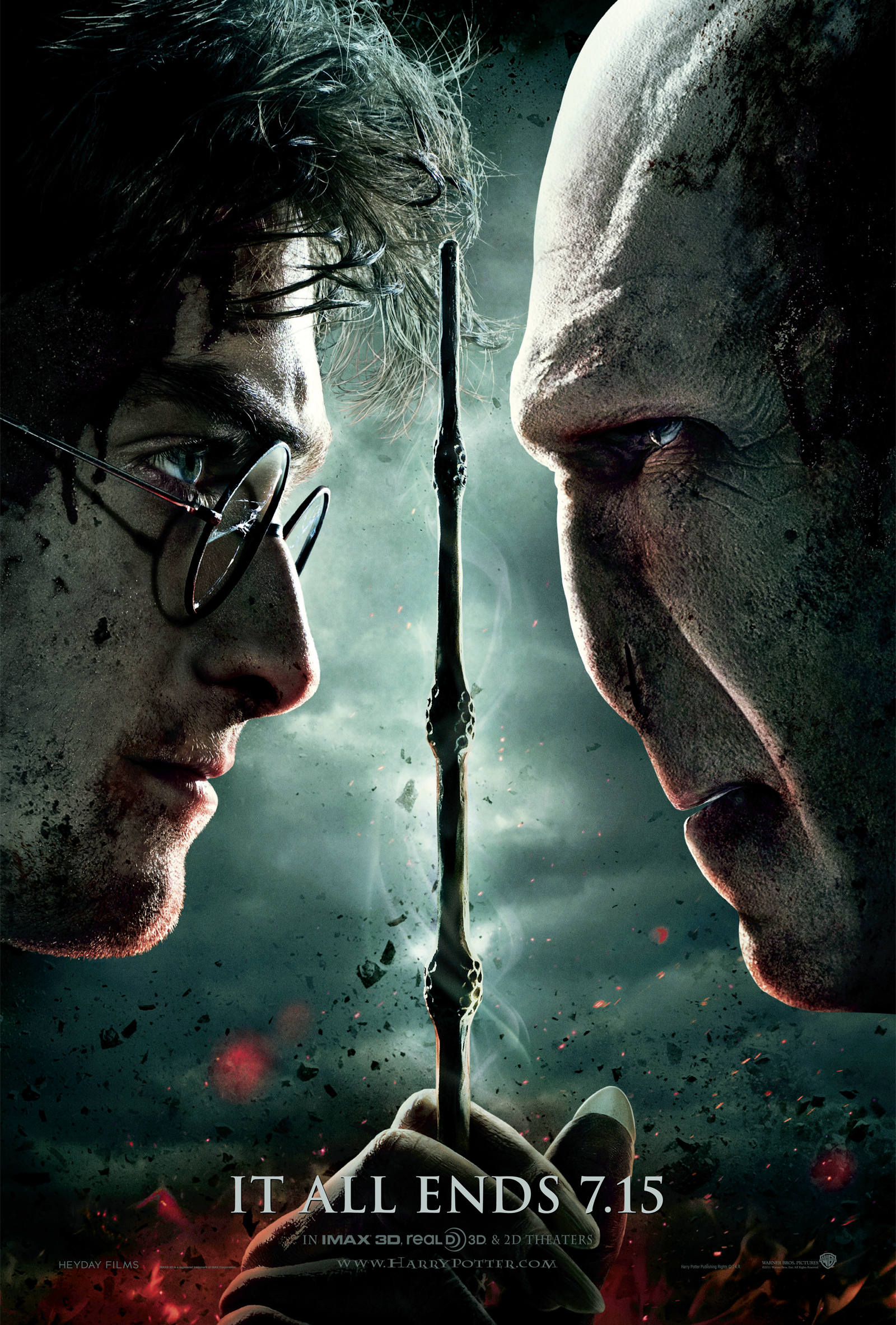
A couple of days ago, the first poster for the last Harry Potter movie was released.  I thought it was awesome in its simplicity.  Harry facing off against Voldemort with only the Wand of Destiny clenched between them.

However, can you think of a more cliched article of fantasy writing than the wand?  What witch, warlock, mage, or sorcerer would not be properly attired without the final touch of this powerful weapon, whether it be a traditional stick of wood or a staff of power...or perhaps even a light saber.

And if you're a writer of fantasy or paranormal, you have probably worked a wand of some sort into your own manuscript.  But as writers, we seek to always bring something new to whatever we create.  And breaking out from old cliched devices is incredibly essential to giving our reader OUR fresh perspective.

JK Rowling does exactly this with her creations, even when they come from traditional lore.  We can learn a lot about putting a fresh spin on an overused device by what she does with her magical wands.

From the very beginning we learn that "the wand chooses the wizard."  Not the other way around.  Wands have their own lore, their own power, their own loyalties, and another's wand will not give you the same results as the one that chose you.  Each wand is unique in its craftsmanship, like the owners they choose, and the wand's maker, like Ollivander, take great pride in their craft and remember every wand sold.

As the series progresses, we see hand-me-down wands, broken wands, brother wands, dueling wands, and spells that tell a lot about wands, such as priori incantatem.  With each of these examples scattered throughout the series, the reader's knowledge of the unique place wands have in this world grows.  Thus, JKR prepares her reader for the final showdown and the most important wand of all.

Since ancient times, sticks of one sort or another have been used as symbols of power and authority over people.  From Pharaoh's was to Moses' rod, to a royal scepter, to the Pope's papal staff -- what person can hold power without brandishing a stick of some sort?  Do we imbue these wands with power because of ancient images of a shepherd's guiding crook, or the disciplinary rod of a father over a child?  Or perhaps they go back even further in our collective memory and hint at a primordial time when the holiest of places, the highest authority, was found in a grove of trees?

Whatever the reason, sticks of wood convey authority and power and JKR used this to her full advantage, with her own twist, in the final book, Deathly Hallows.  The Elder Wand that Harry and Voldemort both seek to claim, the symbol of protection against death, lies in a sacred tomb that Harry refuses to disturb, but Voldemort violates.  It is this attitude that no one matters besides me, contrasted against Harry's self-sacrifice for the love of others, that is ultimately Voldemort's undoing.  No totalitarian authority is allowed to live forever when those oppressed finally are roused to rebel.  Not even the Deathstick, that magical ultimate weapon of mass destruction, can save Voldemort from a simple boy's kindness of heart.  For it is Harry's nonviolent disarming of his classmate Draco which has won the loyalty of the Elder Wand.  And it is his casting of a non-lethal spell into the face of Avada Kedavra, that turns the killing spell back onto its caster, and bring the end to He-Who-Should-Not-Be-Named.

In her intricate plotting, JKR thought deeply of the themes she pursued throughout her series and how these themes would live in the world she created.  Her wands tell us a lot about how the author views the magical world, and our own.  As Dumbledore said, "Voldemort himself created his own worst enemy, just as tyrants everywhere do! Have you any idea how much tyrants fear the people they oppress?" (p. 510, HBP)

Recent events in the MiddleEast have shown what Voldemort learned too late -- even in the real world we witness that how ruthlessly a ruler wields his wand of power is often an indication of how brutally he will be brought down by those who've suffered under him.

Writers -- Look at your symbols, your cliched items of your genre.  What fresh spin can you bring to the tired symbols and tropes?  Think deeply about your story, your world, your hero, and your meaning.  Are your themes reflected throughout?  And if not, what can you do to weave your own Wand of Destiny over your creation and make it truly come alive and sing with your Voice?

Deathly Hallows poster credit
Was scepter image credit

That Extra Zing

When studying the phenomenal world-building of JK Rowling, I like to break her craft apart into three sets: The Wide Angle Lens, the Zoom Lens, and That Extra Zing.

In building your set, not only do you want your reader to experience a fully alive, intriguing world in wideness and detail, but you want some of those details to sizzle with extra zing.

For examples of the Zing, I'd like to share two of my favorite details from JKR's worldbuilding which I think go beyond the ordinary to add an extra, delightful touch.  And better yet, they both happen to come from Christmas!  (Hey! It's still the holidays.  My tree's still up.  The kids are still out of school! :-)

The Hogwarts staff, demonstrating a continued desire to impress the visitors from Beauxbatons and Durmstrang, seemed determined to show the castle at its best this Christmas. When the decorations went up, Harry noticed that they were the most stunning he had yet seen inside the school. Everlasting icicles had been attached to the banisters of the marble staircase; the usual twelve Christmas trees in the Great Hall were bedecked with everything from luminous holly berries to real, hooting, golden owls, and the suits of armor had all been bewitched to sing carols whenever anyone passed them. It was quite something to hear "O Come, All Ye Faithful" sung by an empty helmet that only knew half the words. Several times, Filch the caretaker had to extract Peeves from inside the armor, where he had taken to hiding, filling in the gaps in the songs with lyrics of his own invention, all of which were very rude.
(p. 395, GoF)

Even though this is a lump of description, it’s kept from being boring by the imaginative, unusual detail, and the action within. That last bit, about Peeves filling in rude lyrics, to me is quite witty and adds the extra zing. JKR could easily have stopped with the everlasting icicles, the hooting, gold owls, and the singing suits of armor. That would have provided the whimsical Christmas feel she was after. But in taking it that extra level--the Peeves factor--she truly brings the whole setting to life...and makes it loads of fun.

One of my favorite descriptions on steroids, which I also listed in my post on favorite tidbits from Harry Potter, was the Christmas tree gnome topping the Weasley tree in HBP.

Stupefied, painted gold, stuffed into a miniature tutu and with small wings glued to its back, it glowered down at them all, the ugliest angel Harry had ever seen, with a large bald head like a potato and rather hairy feet.
(p. 309, HBP Bloomsbury)

Those hairy feet add the zing to an already fully-imaginative description. I would love to be able to come up with something so clever, amusing, and imaginative.

As writers, we build a world in whatever story we write, even if that world is the contemporary one most readers inhabit.  Your reader still doesn't know YOUR particular setting.  How you choose to describe that world, and what elements you choose to highlight, will greatly affect the feel and perception of your story by the reader.  Making sure that you've thought your world through in complete detail (even if it is not all given on the page) to include these delightful, zingy nougats, will help your reader to experience your story as a participant and not merely an observer.

What nuance can you add to your perfectly good description to give it that extra sparkle?

A note of caution on zinging -- a little goes a long way.  With ever-decreasing word counts, we have to be very careful to spend words only where important.  Therefore, make sure any extra details you add to your descriptions are truly wonderful AND that they add to your story significantly...preferably in more ways than one!

Gnome picture credit.

Missing Letters to Imagination

Did many of you see a common thread passing around Twitterverse yesterday, September 1?  From agents to HP character impersonators, to Wizard Rockers, to regular fans--loads of people were talking about either catching the Hogwarts Express, or lamenting their missed letters.

Why all this hoopla over a pretend starting day for a fictional school?

Because Hogwarts seems totally awesome to so many people.  And, most importantly, incredibly real.  As one Tweeter put it, Hogwarts is way more fun than his real school.  Who wouldn't want to go there?

Fans love JKR's wizarding world so much that they can't let it go, even though the series is complete.  They must find ways to keep Hogwarts and Hogsmeade, the Burrow and Grimmauld Place alive, playing in its rich imaginary corridors and dungeons constantly.

How real is your world?  How vividly have you imagined your shops and streets, your hospitals and homes?  How strongly have you captured your imagination in black and white on paper or monitor?  Have you put all your effort into giving your reader more than they expect?  Have you provided such richness and authenticity of detail that your fans, too, one day will play in your universe as if it were better than real life?

World building is one of the most important elements that JKR did so right.  It's impossible to cover all her world building techniques in one post, but follow the World Building label below, and I'll keep coming back to it again and again, trying to learn, hoping to unmask her magical secrets.

Because while my Hogwarts letter must have gotten lost in the mail too, :-( , I've got a ticket to an imaginary world of my own creation that thrills me just as well...if not better.

What about you?  Where's your imagination taking you today?

Maturing the Mandrakes

For an example of the zoom detail (see prior article) which JKR weaves in so delightfully, I thought it would be good to look at a bit of world building which progresses throughout one story.

Remember the mandrakes from Chamber of Secrets?  Those wonderful potted plants which Professor Sprout was nurturing to stew up and give to Harry's classmates who had been petrified?  JKR depicted the mandrakes with such humorous, human detail, which was only depicted in one scene in the movie.  But in the books, bit by bit, she showed the mandrakes growing up. I thought it would be interesting to capture this clever progression in one place.

During the first day of classes:
Harry snapped the earmuffs over his ears. They shut out sound completely. Professor Sprout put the pink, fluffy pair over her own ears, rolled up the sleeves of her robes, grasped one of the tufty plants firmly, and pulled hard.
Harry let out a gasp of surprise that no one could hear. Instead of roots, a small, muddy, and extremely ugly baby popped out of the earth. The leaves were growing right out of his head. He had pale green, mottled skin, and was clearly bawling at the top of his lungs.
(p.117 - 118)

Professor Sprout had made it look extremely easy, but it wasn't. The Mandrakes didn't like coming out of the earth, but didn't seem to want to go back into it either. They squirmed, kicked, flailed their sharp little fists, and gnashed their teeth; Harry spent ten whole minutes trying to squash a particularly fat one into a pot.
(p.119)

~~~~~~~~~~~~~~~~~~~~~~~~~~~~~~~~~~~~~~~~~~~~~~~~~~~~~~ 

Right before the Christmas break:
By next morning, however, the snow that had begun in the night had turned into a blizzard so thick that the last Herbology lesson of the term was canceled: Professor Sprout wanted to fit socks and scarves on the Mandrakes, a tricky operation she would entrust to no one else, now that it was so important for the Mandrakes to grow quickly and revive Mrs. Norris and Colin Creevey.
(p.250 - 251)

~~~~~~~~~~~~~~~~~~~~~~~~~~~~~~~~~~~~~~~~~~~~~~~~~~~~~~

In early February:
There had been no more attacks since those on Justin and Nearly Headless Nick, and Madam Pomfrey was pleased to report that the Mandrakes were becoming moody and secretive, meaning that they were fast leaving childhood.


"The moment their acne clears up, they'll be ready for repotting again," Harry heard her telling Filch kindly one afternoon. "And after that, it won't be long until we're cutting them up and stewing them. You'll have Mrs. Norris back in no time."
(p. 298 - 299)
Note: this is really quite gruesome when you think about it. Professor Sprout is nurturing these baby mandrakes in order to cut and stew them up.


~~~~~~~~~~~~~~~~~~~~~~~~~~~~~~~~~~~~~~~~~~~~~~~~~~~~~~~

Sometime in March:
It was now nearly four months since Justin and Nearly Headless Nick had been Petrified, and nearly everybody seemed to think that the attacker, whoever it was, had retired for good. Peeves had finally got bored of his "Oh, Potter, you rotter" song, Ernie Macmillan asked Harry quite politely to pass a bucket of leaping toadstools in Herbology one day, and in March several of the Mandrakes threw a loud and raucous party in greenhouse three. This made Professor Sprout very happy.

"The moment they start trying to move into each other's pots, we'll know they're fully mature," she told Harry. "Then we'll be able to revive those poor people in the hospital wing."
(p. 318)
 
Notice the detail with which the mandrakes progress from baby to adult:

Baby -- mottled skin, bawling at the top of their lungs, squirming, kicking, flailing their sharp little fists, and gnashing their teeth

Young Child -- needing to be fit with socks and scarves against the cold, as a mother would bundle-up her child

Adolescents -- moody and secretive, with acne

Older Teens -- throwing a loud and raucous party

Adults -- moving into each other's "pots"


This is a simple, quick example that I find funny and delightful.  It shows the extent to which JKR builds her world by zooming in on detail that adds a rich layer of interest and amusement for the reader.  Not only does she concoct a potion with a plant that in historical folklore was thought to embody human properties, but she imagines those human features in full, captivating detail, from the flailing fists of an infant to the loud, partying teen.

Think about it.  JKR could have just presented a funny looking plant, mentioned once and then forgotten -- as many writers would have.  But by describing the plant as it matures, she not only gets to introduce some amusing (and gruesome) imagery, but also provides an important plot point.  After all, it is because Professor Sprout has to wait for the baby mandrakes to mature that those petrified must remain stone-silent, guarding their secret knowledge of the Chamber of Secrets' monster, until the climax at the end of the school year.

It's this kind of exquisite craft that so engaged her readers.  Taking it to that extra level is what makes JKR so successful.  And yet, she built these descriptions with just a few sentences here and there, woven into conversation that helped forward the plot as well.

As writers we need to challenge our world building to imagine our creation in such minute and sensory detail that we can bring it fully alive to our reader -- with as few words as necessary.  Challenge your world.  Where can you take it further?  Where can you add, with minimum words and phrases, the little extra nuance to breathe your world to full life and delight your reader?

What zinging detail have you added to a recent story to make it pop?

Zooming in on Your World

In the last post, The Wide-Angle View of World Building, we looked at how JKR used a wide-angle lens to provide the feel of a fully bustling world for her reader. Now let's look closer at the rich texture she provides through a zoom lens.

JKR filled her world with such minute details, and loads of them, that her critics claimed it was over done. But consider her primary market--kids eat this stuff up, quite literally:

• Bertie Bott's Every Flavor Beans
• Drooble's Best Blowing Gum
• Chocolate Frogs
• Cauldron Cakes
• Licorice Wands
• Pepper Imps
• Sugar Quills
• Blood Flavored Lollipops
• Cockroach Clusters
• Fudge Flies
• Butterbeer
• Gillywater
• Ogden’s Old Firewhiskey
• Pumpkin Pasties
• Jelly Slugs
• Acid Pops
• Hagrid’s Treacle Fudge
• Magotty Haggis (served at the Deathday Party)

This is a short list, just to give you the idea of the minute and interesting detail she puts into every ounce of her worldbuilding. Notice not only does she pay attention to the foods that her characters eat, but she made her confections fun and appealing to her age group.  I mean, who couldn't love a cockroach cluster?

Here's another list for a slightly different focus:

• Advanced Potion-Making by Libatius Borage (includes the Draught of Living Death)
• An Appraisal of Magical Education in Europe
• The Beaters' Bible by Brutus Scrimgeour (wonder if he’s related to Rufus Scrimgeour)
• Broken Balls: When Fortunes Turn Foul
• Curses and Counter-curses (Bewitch Your Friends and Befuddle Your Enemies with the Latest Revenges: Hair Loss, Jelly-Legs, Tongue-Tying, and Much, Much More) by Professor Vindictus Viridian
• The Dark Forces: A Guide to Self-Protection by Quentin Trimble
• Death Omens: What To Do When You Know The Worst Is Coming
• The Dream Oracle by Inigo Imago
• Guide to Advanced Transfiguration
• Hairy Snout, Human Heart
• A History of Magic by Bathilda Bagshot
• Hogwarts: A History (a major treasure troves of information)
• Magical Water Plants of the Mediterranean (talks about Gillyweed)
• Magick Most Evile (mentions the Horcrux)
• The Monster Book of Monsters
• Moste Potente Potions (includes the Polyjuice Potion)
• Nature's Nobility: A Wizarding Genealogy
• Olde and Forgotten Bewitchments and Charmes
• Prefects Who Gained Powerhttp://www.blogger.com/post-edit.g?blogID=5330251478298712601&postID=4772635350047624639
• Quintessence: A Quest (a clue to the series' theme)
• The Rise and Fall of the Dark Arts
• Unfogging the Future by Cassandra Vablatsky

What is really cool about this list of books, beyond the fact that I'd like to buy them all, is that most of them are not just throw-away detail, but contain clues toward the series. Indeed, most of her details add something beyond mere description, whether hiding or highlighting a clue, or providing information on the backstory of the characters and setting. Very little of her zoom details are thrown in just as fluff.

The details you will add to your story will vary greatly by genre and target audience. A mystery should be filled with clues or red herrings. A romance will be packed with hints of the developing love between characters, with their backstory packing emotional luggage. A thriller or suspense should have details that hike the tension and darken the feel.  But make each one serve double-duty, not just to lay building blocks for your world, but to also build character, hide clues, highlight themes, and hint at the plot to come.

What fun worldbuilding details have you layered into your world? And what purpose do they serve beyond mere window dressing?

Also Recommended:

See TS Tate's World Building and a Cure for the Block.  She gives excellent examples of how JKR uses sensory details to build her world!

The Wide-Angle View of World Building

Most readers cite JKR's world-building as the lure that drew them into the Harry Potter series to begin with. JKR riddled the text with so much fabulously imaginative, fun, and complete detail that readers fully believed, for the few hours they were engrossed in the books, that they were indeed living in a world among wizards and witches, goblins and house-elves, giants and ghosts, and basilisks and hippogriffs.

JKR uses many layers to create her world. Her rich details come into focus through both a wide-angle and zoom lens. The reader experiences these angles simultaneously, but in this post, we'll look at the wide.

I find it highly significant that Harry’s introduction to the Wizarding World was not at Hogwarts but at Diagon Alley. Think about it--JKR could have had Harry’s books and supplies provided by the school once he arrived. But she wanted Harry, and the reader, to experience from the start that the Special World Harry was entering was full and complete and only diagonally set apart from our own.

At Diagon Alley, in that first visit with Hagrid, Harry encounters:

  • The Leaky Cauldron, Tom the barman, all the customers who are thrilled to finally meet him ... Doris Crockford several times

  • Gringotts, the wizarding world bank, where he meets goblins and hurtles hundreds of miles below London on a wild amusement park ride, past an underground lake and dragons, to his own vault of gold

  • A snotty rich kid trying on robes at Madam Malkin’s who asks if his parents were “our kind”

  • Flourish and Blotts, the Apothecary, and Eeylops Owl Emporium as he acquires his books, quills, parchment, a cauldron, potion supplies, and a birthday gift from Hagrid--Hedwig

  • Ollivanders, where his wand chooses him and he learns the special connection he has, through his wand’s phoenix core, to He-Who-Must-Not-Be-Named
All of that in one chapter. As the book and the series progress, Harry's Special World, like Perkins’ tent or the trunk of the Ford Anglia, magically enlarges even more. Throughout the series, the reader experiences: Setting -- (Muggle Equivalent) Hogsmeade -- (an entirely magical village)
St. Mungo’s -- (Hospital)
Ministry of Magic -- (Government)
Department of Mysteries -- (Research Facility)
Beauxbatons and Durmstrang -- (Foreign Schools)
Azkaban -- (Prison)
The Burrow -- (the Weasley home)
Grimmauld Place -- (Sirius Black’s home and Order headquarters)
Godric’s Hollow -- (Lily and James’ home village)
Quidditch World Cup -- (The World Soccer Cup)
The Daily Prophet -- (Newspaper)
The Quibbler -- (like the National Enquirer)
Little Hangleton -- (Riddle and Gaunt hometown)
Tom Riddle’s orphanage -- (Riddle’s “home”)
Tom Riddle’s cave -- (Riddle’s hiding place)
Slughorn’s home -- (Muggle dwelling)
Malfoy Manor -- (Rich "gated" mansion)

This list is by no means exhaustive. The reader, and Harry, experience a vibrant world thriving and performing on a daily basis. A world full of people who are going to be affected by Harry’s choices. Some of these people would live or die as a direct result of Harry’s actions.  And if the reader is going to be affected by their fate later on, they need to experience them and their world personally beforehand.

Have you fully realized the world your hero or heroine inhabits? Have you built the bank, the prison, the government, the newspapers, the books, the schools, the playgrounds, the hospitals, the homes, the shops ... even if your reader may not ever go there? A variety of settings not only provides the feel of a fully developed world, but helps prevent the reader from getting bored.

What other wide-angle settings from Harry Potter can you remember?

Be sure to check out JKR's Zoom Angle of Worldbuilding as well.

** Credit to Neville at Sodahead.com for the Diagon Alley picture.